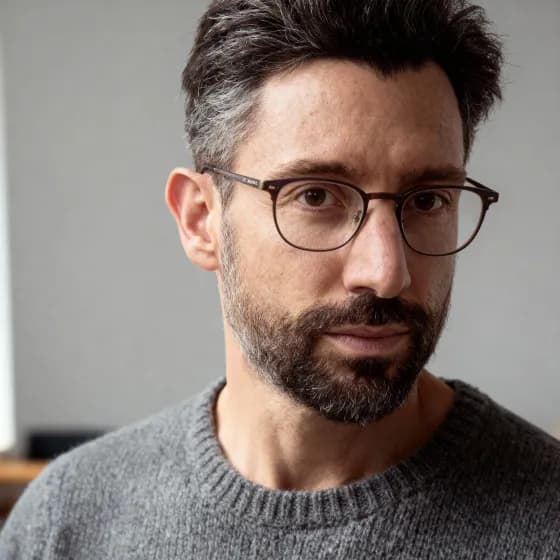
I Write to See Clearly
I came to artificial intelligence by a side road. Film first—learning to see before learning to build. Then audiovisual production, code, architectural photography. It’s not a linear path because I’m not a linear person.
Something settled with each transition. From cinema: an eye for composition, atmosphere, what an image communicates without anyone having to spell it out. From architecture: a way of thinking about systems that actually hold up—ones with an internal logic independent of their appearance. From writing—because I also write short fiction about the anxieties of modern life—a conviction that the form you choose to think through a problem changes the problem itself.
I dig until I hit the fundamental mechanism, until the whyis resolved. I distrust truths I haven’t tested myself, trends I haven’t taken apart, consensus that holds together more through repetition than through substance.
In a room full of people, I’m usually the quiet one. Not from indifference—I’m observing, mapping, analyzing. It’s afterward, alone, that it transforms into something usable: an analysis, an architecture, a narrative.
The Last OS was born from that place. Not from a need to perform expertise. From an attempt to write in order to understand, and to share what deserves to be shared.
The central idea—that we are living through the transition to the last operating system humanity will ever create—is neither a prophecy nor a marketing promise. It’s an observation. And like all truly important observations, it is both obvious once stated and deeply uncomfortable to face head on.
I don’t write to reassure. I write to see clearly.
Philosophy
Depth over surface
Every analysis goes to the root mechanism. Curiosity that won’t stop halfway.
No borrowed convictions
If I haven’t tested it, deconstructed it, or stress-tested the consensus—it doesn’t make it into the work.
Form shapes thought
The medium isn’t neutral. How you frame a question changes what answers become possible.